Saturday, 2 March 2019

Cash flow Forecasting

Why cash forecasting?
A cash forecasting model is an essential tool for treasuer to manage working capital. Forecasting preempt treasurer of
  1. Early warning of potential payables in future which resulted in preparing optimal cash reserves early to meet this obligation.
  2. Optimize cash buffers. Having information about projected cash inflows allows treasuer 
    • To invest the surplus in a reasonable amount
    • Reduce the burden of having too much cash 
    • Reduce losing an opportunity to invest in higher yielding products (short term).
Source of information to structure cash forecasting
Information is sourced from 2 key areas internally, mainly from treasury and business flow. 

  • Treasury: Cash balances (Accuracy depending on getting timely information on accounts eg: MT942 updates, using sweeping/pooling solutions), FX related transactions (eg: forwards, swaps), investments
  • Business: Payables, receivables from finance, sales team
  • Other sources of information can be retrieved from industry reports from government associations, business magazine or forecast service companies focusing on specific industries.

The accuracy of the forecasting depends on the information feed into the model. For a reasonable degree of accurate forecasting, as much as possible, scheduled items must be included, for example, payroll, monthly bills/expenses & regular receivables.

The impact of different sources & time frame may result in less accuracy in forecasting.
  1. Using weekly payment & receivables provide accurate forecasting between 1 to 2 month period
  2. Using 3 to 6 months projection, for example using information from industry reports & forecast are less accurate compared to the former
  3. Using a budget 0r sales forecast for longer projection
Improving cash forecasting accuracy
Improving its accuracy requires automation and constant feedback and checks on the forecasts. 

1) Automation helps to gather and consolidate different inputs/sources can significantly improve reliability and accuracy. It also helps the treasurer to direct their time and focus on other productive aspects of their work scope. 

However, even with automation, inaccuracy still exists. For example:

Payables & Receivables
Potential problems where invoices are sent/mailed by suppliers and invoices are circulated internally for approval resulting in appearing late compared to the forecast as it is key into account system. This is common in companies with old practices that require a signature on the invoice from management to approve the payments.

As for receivables, companies may issue late invoices if there are no ERP to manage the collections.

Solution: 
A possible solution is to input the invoices into the system first before sending out for approval. Or establishing with suppliers to submit invoices directly into TMS or ERP system. 

For receivables, a possible solution is to use direct debit for prompt collections or automate the generation of invoices and send to customer ERP system directly.

Sales forecasts
Sale team are reluctant to provide detailed forecasts as they do not want to be held accountable

Solution: 
Getting constant feedback from sales and regular reviews with a compensation plan for them.


2) Regular reviews on the forecasts by having regular reviews on the forecast and compare with previous forecasts by having controls to investigate variances from preceding forecast to verify the changes. Matching forecast against a checklist helps to review if anything is missed out. Lastly getting approval from all various department and sources to verify and contribute.

Forecasts should distribute regularly to match periodic of outflows and inflows. Forecasts should also be updated monthly/quarterly/annually to reflect the business cycle and changes.

Summary
  1. To create a better cash forecasting tool, it is advisable to establish process and procedures and checklist on the source of information by treasury staff. 
  2. Establish the source of information, dates, amount from:
    • Payroll dept on schedule payments 
    • Payment dept on payments
    • Collections dept for receivables
    • Treasury or finance on investments, capital expenditures intercompany loans
    • Sales forecasts from sales dept based on past history of sales outstanding
    • Company expenses
  3. Review and apply reasonable views on the sources and draft forecasts
  4. Approved and issue the forecast


Saturday, 16 February 2019

Treasury Centres, In-house bank and Shared Services Centre. What are the differences?

I received a question asking me what is the difference between Treasury Centre (TC), In-house bank  (IHB) and Shared Services Centre (SSC).

One similarity between TC, IHB and SSC is centralizing in one location. As for the difference, we will understand more if we look into what objectives and activities for each of them.

Treasury Centres (TC)
TC is responsible for managing and strategize its company liquidity by monitoring their cashflows, to decide if require additional capital through borrowings or capital raises. TC is also responsible for managing investment assets, internal processes, FX and making decisions on changes to working capital. 

Roles of TC includes the following below:
  1. Cash forecasting
    • Measuring the accuracy
    • Determine the information sources for the forecast
    • Establish controls, policies and procedures of cash forecast
    • Automating cash forecasts
  2. Cash Management
    • To manage the flows (payments and receivables) with objectives on costs savings and effectiveness
    • To manage balances with objectives to reduce liquidity & credit risk, cash balances efficiencies
  3. Investment Management
    • Managing surplus funds not required for operational activities or bank obligations (fees, overdraft)
    • Consider the types of investment, strategies, goals and criteria
  4. Treasury risk management
    • Establish and allow better overall control over group-wide, information and policies on risk management
    • Better pricing on FX hedging and better pricing
  5. Managing banking relationships
    • Negotiate consolidate pricing
    • Concentrate on core banks to strengthen the relationship
  6. Raising capital
    • To raise capital via borrowings or equity issuance
    • Working with sell side (bank) to offer company bond and equity offerings
  7. Granting of credit
    • Manage and establish procedures to grant credit to customers/suppliers to have some control on working capital locked in receivables
  8. Maintaining credit rating agencies relationships
    1. Treasury responds to credit rating agencies and provides information to maintain their credit rating which will help in getting cheaper debt

In-House Bank (IHB)
IHB is often used and refers as treasury centre as its solutions offer centralized payment flows and balances by executing all flows through the operating companies’ internal multi- currency accounts from 1 location.
IHB is actually a corporate tool for financing purpose using company resources for treasury functions. It is used to execute payment or receivables flows by performing netting on all payments from the group which resulted in savings as fewer payments are executed. 
Cash visibility is improved as balances are maintained in inter-company accounts instead of decentralized individual accounts

As for balances, IHB can leverage balance tools such as cash concentration, notional pooling, interest optimization and managing intercompany loans. Tax needs to be considered as well when executing intercompany loans within the group entities.


Shared Services Centre (SSC)
If IHB is used for execution, SSC is responsible for processing the flows. In my previous post on SSC, it  is centralizing operational & back-office routines such as making payments, collecting receivables, reconciliation, confirming & executing, reporting, 

In transaction banking perspective, its role involves processing payments commonly x-borders payments, reconciliation, FX processing, invoicing etc. My previous post on SSC can be found here.

Summary
In summary, TC is more focusing on the strategies to manage liquidity. IHB is a financing tool employed by TC for cash management and used for execution on behalf of entities. SSC is focusing on processing for payments/collections, reconciliation, operation and backoffice matters.


Monday, 4 February 2019

Shared Service Centres (SSC)

Technologies advancement and corporates looking for solutions to reduce complexity and reduce replicated operations for their business in each geographical area has prompted them to look for Shared Service Centres for answers.

Shared Services Centre (SSC) Vs Outsourcing

  1. Is SSC equivalent to Outsourcing? To be exact, outsourced services are provided by an external company while SSC is provided by an internal organizational entity
  2. Internal customers of SSC have control in the cost and quality of the service they receive

SSC vs Treasury Centres
  1. SSC is actually centralizing operational & back-office routines such as making payments, collecting receivables, reconciliation, confirming & executing, reporting,  Payroll etc.
  2. Treasury, on the other hand, manage treasury related matters and strategies such as maximizing deposit returns, loans and risk management using derivatives such as swaps, forwards for hedging
    • Treasury also look at debt management by managing debt and establishing control
    • Investment management such as using strategies to manage investment i;e: matching strategy, laddering or tranched cash flow allocations
    • Interest and equity management
  3. SSCs are typically processing on behalf of operating entities, while treasury centres is working more on the importance of managing the working capital and strategies of the corporate
  4. SSCs do not need to be tax efficient as they do not process for their own books unlike treasury centres as they are booking transactions in their own books. For example Treasury centres moved their routine payment flows to SSC. SSC will initiate payments from accounts maintained in the treasury centre. These bookings are maintained in TC books instead of SSC as these accounts are held under TC entity name.

What are some considerations required to do to establish a SSC?
  1. Talent in the geographical area and labour costs
  2. Language and communication
  3. Financial infrastructure in that geographical area
  4. Ensure internally what operations are to be managed by SSC, what to consolidate and centralize with established best practices to track KPI
  5. To invest in training and recognize the importance of employees

What are the benefits for having a SSC?


From: https://www.treasury-management.com/article/4/73/665/a-shared-service-centre-for-treasury-operations.html

Friday, 1 February 2019

Project Ubin Phase 2. Exploring Corda, Hyperledger Fabric and Quorum for RTGS clearing/settlement

There are interesting results and findings from this project to explore using DLT for RTGS settlements. In one of my earlier post, I mentioned that one of the uphill tasks is convincing the banks to participate in Ripple's DLT.

In order for banks to work seamlessly with DLT, banks may have to upgrade or overhaul their existing system. That boils down to what choices to make.

  1. Continue to use SWIFT which is already mainstream for x-border payments or 
  2. using DLT where there is no concrete proof of concept that it can work or create future unforeseen issues
Project Ubin Phase 2 is using 3 DLT, Corda, Hyperledger Fabric & Quorum for RTGS settlements with focus on funds transfer, queuing and resolving gridlocks. Each of these DLT presents their plus and minus features of the DLT which I will list below shortly after viewing their report from Accenture.

There are more than 1 DLT in the market but seldom I see there are comparisons done for each of them at solving real world problems. The report from this project revealed the findings

In gridlock resolution, Corda uses Cycle solver algorithm developed by themselves and Hyperledger and Quorum uses EAF2 algorithm . The EAF2 algorithm is the earliest FIFO-based algorithm used in Germany.


Corda
Extracted from the report: "Corda is a distributed ledger technology platform designed for use with regulated financial institutions. It is designed for recording, managing and synchronising commercial agreements between known and identified parties at scale without compromising privacy"

Plus points
  1. To cater to privacy requirements, Corda shares with banks on need to know basis rather than broad broadcast
  2. The funds transfer is able to continue even when there is gridlock resolution running
  3. High resiliency as a network can still operates even when some nodes failed
  4. New banks integration is easy when  adding a new participating node involves only the installation of the new node itself.
Minus points
  1. Its UTXO model requires input states to link 1 or more transactions creating a long chains which makes processing slower as time goes by
  2. As single  Notary service (Provides uniqueness and/or validating consensus on received transactions by providing signature to indicate transaction finality.) was used, it introduced a potential single point of failure. If the single notary failed, transactions cannot be completed

Hyperledger Fabric

Extracted from the report: "Hyperledger Fabric is a permission network with the ability to set up private channels between participants where each channel maintains an independent ledger. Channel enables information to be shared between parties on a need-to-know basis."

Plus points
  1. As this DLT allows channels for bilateral exchange which are private and having their own ledgers, speed in high when it comes to processing
Minus points
  1. Difficult to maintain in future as channels will increase with increase participants
  2. New payments are queue if there is gridlock resolution running
  3. If orderer (An orderer broadcasts the transactions to all peers in a channel for validation before committing the transaction) fails,it presents a single point of failure to network
  4. Requires funding to account for each channel

Quorum
Extracted from the report: "Quorum supports both public and private transactions within the permissioned network. The public transactions are broadcast to all the nodes within the network and are processed like regular Ethereum transactions. The private transactions are sent directly to the specified recipients by Quorum’s privacy service Constellation as encrypted blobs."

Plus points
  1. If any Quorum node is disconnected from network, the rest of the network can still function as normal.
  2. Supports private and public transactions
  3. It sends hashes to all participants and if a participant requires validation of transaction in future, they can confirm with the rest of the network by comparing to hashes that network holds without having to trust their counterparty
Minus points
  1. Zero-knowledge proofs generation is slow and consumes computing power
  2. New payment instructions submitted is set as 'Inactive' and will not be processed during gridlock resolution processing
  3. DAPP orchestrated the settlement transaction and if it fails, entire netting round fails for finality stage

Thursday, 31 January 2019

BlockChain solutions for banking

What is the problem?
Current payment processing especially cross border transaction creates a few problems for the banks especially on the management of correspondent relationships, Nostrol accounts maintenance, inefficient settlement process and regulatory issues in today's landscape.

Correspondent relationships
The traditional method for cross border transaction is processed via correspondent banks. Relationships with these banks recently become expensive due to regulatory issues. Blockchain/DLT can solve this problem if all banks in the world join the network.

Interestingly, the recent case between Danske and Deutsche where Deutsche Bank was their correspondent bank used by Danske’s Estonian branch where money flows (euros 2 billion) from Danske are suspicious and whether Deutsche should be held responsible for processing these transactions.

I guess most banks are interested to know the end result of the investigation whether banks should be held accountable for the actions of their correspondent customer and fear if they could be penalized for breaking AML regulations from the actions of their customer's customers.

Nostro accounts
To start x-border transactions processing, each of these accounts are pre-funded with the country's domestic currency which creates an opportunity cost for the banks.

SWIFT DLT proof of concept is working on this to reduce nostro-vostro liquidity. Ripple introduce their own cryptocurrency to solve liquidity issue in NOSTRO accounts as well.

Settlement process
Every MT instruction will move through each correspondent agents based on their technology capabilities, time zone, AML management procedures, reconciliation process to check if funds arrive etc. Furthermore, as instruction passes through each agent, costs increases due to fees impose from each bank and delays in settlements. These create uncertainty in costs.

DLT can resolve this where their technology is able to provide real-time settlement as highlight by Ripple. Of course, provided all banks join the same DLT network.


Ripple Distributed Ledger Technology (DLT)

Ripple is one of the first solution providers which I touched base focusing on enhancing x-border payments processing. Therefore I would want to touch on them below after attending their seminar.

From what I have understood, their objective is to solve these problems which I mentioned earlier by building a real-time gross settlement system for cross border transactions with lower costs, near real-time settlements.

Some of their product solutions are:

RippleNet
one network with all banks participated that forms a network to send and receive payments using their DLT platform with a common set of SLA agreed upon by all participants.

Correspondent relationships can be reduced if most banks participate in this network

X-current
It is their enterprise solution which consists of several modules to act as an RTGS system to facilitate real-time settlements and tracking of payment instructions end to end. The modules include validator, messenger, fx ticker and interledger protocol

Settlement time can be reduced or even in real time with this solution

XRP currency
In my view, XRP currency can resolve the issues of banks parking their funds in different currencies for each domestic country where their Nostro is held thereby creating opportunity costs. By using XRP, banks can allocate less liquidity in domestic currency to process the same volume of cross border payments.

However, using cryptocurrencies invite many questions and debates partly due to the stability of the value with political challenges as well.

xRapid
Its uses their cryptocurrency, XRP to offer financial institutions a reliable liquidity solution to service cross-border payments. Created for liquidity market makers who provide liquidity and exchange between XRP and any other currency so that banks do not need to hold local currency in their NOSTRO accounts.

Final views about DLT solution
DLT is an excellent solution but the major uphill tasks are getting the banks to join these network, going against industry norms as banks are using SWIFT.

SWIFT has already had a roadmap for their GPI to close the gaps surfaced for the past 20 years. However I do not think this is the end of DLT as Singapore has embarked on project ubin to explore the uses of DLT.


Friday, 21 December 2018

Project Ubin Phase 1

It's interesting to read from MAS report about their trial with Ethereum DLT using tokenization SGD currency for payment processing (processing is decoupled from our RTGS system) without creating any monetary inflation in balance sheet bt recategorizing the cash balance to depository receipts.

Tokenization SGD
Before this, digital money exists electronically in stored value cards (Ezlink for example) for retail.
The proof of concept touches on using digital money to process payments instructions with the central bank and its implications.

Money from participants are kept in a collateral account with central bank to reduce credit exposure. Participants are free to convert these digital currencies to fiat anytime as well

How does it works?

  1. Notably. a new account(008 account) is created with central bank to serve as an account for collateral
  2. Participant sends an top up instruction to MEPS to top up the blockchain account (008 account)
  3. Funds will be transfer to 008 via G3
  4. MAS will verify the validity of the collateral to proceed with the DR issuance via transaction agent Smart Contract.
  5. Participants will exchange value with each other via DLT which is decouple from RTGS system.


Ability to process payments without RTGS
It's interesting to note that payments can continue to process in DLT using tokenize currency which adds on resiliency to processing and decreases the impact of systemic risk in case RTGS system is down.


*Both images are from Deloitte report which can be download from this website. http://www.mas.gov.sg/Singapore-Financial-Centre/Smart-Financial-Centre/Project-Ubin.aspx

Thursday, 15 November 2018

Australia New Payments Platform (NPP)

Key takeaways for NPP
  1. Operates 24/7 at 365 days
  2. Using of ISO20022 format and the use of this format allows sending more remittance information with the payment instruction
  3. Initiate payment without account number by using PayId with addressing service
  4. Settlement method is not on netting basis and payment gateway of each ADI will send a settlement instruction to FSS for settlement
  5. Settles real time within 15 secs via FSS allocation which is be linked to ESA accounts via a sweep to balance positions
  6. Extending the access to APP via API

Accessing the platform
There are 5 ways to access the platform
  1. As an end user: Businesses, corporates, fintechs, retail individuals, can use NPP to make and receive payments as an orderer and beneficiary
  2. As direct participant: Consists of licensed ADI or restricted ADI that connect to the platform for clearing and settlement and meeting the technical requirements Payment Access Gateway
  3. As identified institution: Offer their customers real-time data-rich payments via a directly connected NPP Participant who can clear and settle those payments on their behalf. These entities are not required to be ADI or RADI
  4. As Overlay services provider: 
    • A product or service that uses the NPP’s capabilities in a customized method
    • The 1st overlay service is OSKO by BPay
  5. As connected institution: 
    1. Connect to the NPP directly by installing an NPP Payment Access Gateway in their own environment in order to be able to send payment initiation and other non-value messages.
    2. Not required to be ADI or RADI as they are not processing or clearing the payments
    3. Able to access the addressing service
    4. These organizations can be payroll providers, share registries, retailers, large corporates,fintechs or organizations like Amazon, Facebook and Google.


API framework for NPP

  1. To allow organizations to take advantage of overlay services, NPP released a framework for API development
  2. Schema is using JSON for set of HTTP request messages, along with a definition of the structure of response messages
  3. Payloads should be designed based on existing ISO 20022 message elements
  4. NPPA in collaboration with SWIFT have launched a testing/sandbox environment that will allow fintechs and other third parties to start learning and testing the benefits and capabilities of the NPP using demonstration versions of APIs defined by the NPP API Framework
  5. This API sandbox, hosted in the cloud and protected by state-of-the-art security


NPP clearing and settlement process


  1. The process described below is summarized. For detailed info, refer to the links I shared below
  2. Orderer agent sends a PACS.008 message for clearing
  3. Beneficiary agent receives the PACS.008 message, processed and returns back a status file in PACS.002 format
  4. Once clearing is completed as described in point 1 and 2, orderer agent will send a PACS.009 message to FSS for settlement unitary after receiving the status message from the beneficiary agent
  5. FSS will send a confirmation message to both agents in PACS.002
  6. Beneficiary agent will allow the fund to be available to its customer after receiving a positive status message from FSS


Managing liquidity between ESA and FSS accounts

  1. NPP allows participants to manage their liquidity by setting upper and lower trigger points to automatically allocate ES Funds to or from the FSS Allocation
  2. If FSS falls below the threshold level, RITS will automatically initiate a top-up from the RITS Allocation to restore the FSS Allocation to a Member nominated reset point
  3. If the balance in the FSS Allocation rises above the upper threshold,  funds above the reset point will be automatically withdrawn from FSS allocation to ESA
  4. Triggering of moving the funds when it hits the threshold levels happens during RITS operating hours
  5. If RITS is not operating, funds in ESA will move to FSS allocation
  6. RBA offers intraday repurchase agreements (repos), which carry no interest charge but must be reversed later that day, to help institutions manage their outgoing and incoming payment flows through their ESA


Calculation of ESA interest

  1. ESA interest is will be calculated on the basis of total EOD balance in ESA accounts, at midnight, seven days a week. 
  2. ES Funds in both the RITS Allocation and FSS Allocation will be included in the end of day calculation. 
  3. Interest will be paid monthly in arrears on the 1stRITS business day of each month.


  1. https://www.rba.gov.au/publications/bulletin/2018/sep/the-new-payments-platform-and-fast-settlement-service.html
  2. https://www.rba.gov.au/publications/fsr/2018/apr/box-d.html
  3. https://www.nppa.com.au/the-platform/accessing-the-platform/
  4. https://www.cuscalpayments.com.au/news/white-papers/using-the-new-payments-platform/
  5. https://www.theglobaltreasurer.com/2015/11/26/australias-npp-and-its-impact-on-payments/


Tuesday, 2 October 2018

Australia Corporate Treasury Market

Australia has diverse markets for its economy with the majority within services covering 61% of its GDP, construction 8.1%, mining 6.9%, manufacturing 6%.

Though mining is only approx 7% of its GDP, Australia is the world's largest exporter of coal. Australian mining companies are essential to China's growing economy and strong investment from China has tightened relationships between these 2 countries, making China Australia's largest trading partner. That also explains why the recent trade war between US and China will negatively impact Australia.

Corporate treasury services

  1. There are no exchange controls on its currency and foreign entities making direct investments in Au are cross-checked by the foreign investment review board. 
  2. Its financial service is supervised by Australia prudential regulatory authority and RBA is responsible for monetary policy with the objective of maintaining a strong financial system and stability.
  3. AU is a founding member of FATF and played roles in drafting FATF recommendations
  4. Australia has anti-money laundering and counterterrorism-financing legislation in place.
Banking service
A highly competitive sector with 54 authorized banks where 40 are foreign owned and 14 domestic with Commonwealth Bank of Australia, ANZ, Westpac and NAB having the majority.

Taxation
Tax on corporate income is 30% with capital gains are taxed as income. Interest paid to Non-resident has 10% withholding tax and thin cap maximum allowable debt is 3:1. Interest expenses that are used for business purposes are generally tax deductible. Australia has tax treaties with more than 40 countries and territories.

Accounts
Accounts are available in domestic and foreign currency with no restrictions. For non-residents, they can hold foreign and domestic currency accounts and domestic currency accounts are freely convertible to foreign currency.

Liquidity management solutions
  1. Interest optimization, notional pooling, and cash sweeping are allowed for resident and non-resident.
  2. Banks offer interest-earning accounts and able to move surplus to higher earning accounts overnight. 
  3. Allow short term investments via CDs, government securities, bank accepted bills and commercial paper
Regional treasury centres
  1. Its financial centres are in Sydney and Melbourne with an established legal system, highly skilled English-speaking workforce and excellent business infrastructure.
  2. In 2017, Australia positioned itself as a renminbi settlement hub for the Asia-Pacific region. 
  3. Their foreign-exchange market is liquid and the established clearing and settlement systems to facilitate smooth financial transactions
  4. They have also recently launched NPP in 14 Feb 2018
  5. Australia is also a member of APN (Asia Payment Network)
  6. Electronic and internet banking are very prevalent in the country and available from all major banks

Payment systems

RITS

  1. RITS, AU RTGS settlement system operated by RBA
  2. Final settlement is done through exchange settlement accounts (ESAs) maintained at the RBA.
  3. Processes participants' transactions in the securities settlement systems, Austraclear and the Australian Stock Exchange's Clearing House Electronic Sub-register System
  4. Perform settlement for participants' net balances from other clearing houses.
  5. Settles interbank transactions in real time and with immediate finality if funds are available in ESA
  6. Recently FSS, FAST Settlement System is launched with 24/7 service

NPP

  1. Recently launched payment system to settle payments for business, retail consumers and governments
  2. Payments are cleared and settle in real time unitary
  3. PayID feaure to initiate payments without account numbers
High value clearing system

  1. Processes high value and urgent interbank transfers for the AUD currency portion of FX transactions
  2. Payments processed in real time and immediate using the SWIFT Payment Delivery System (PDS) and then settled unitary with RITS.
Australian Paper Clearing System

  1. Processes AUD-denominated cheques and MICR paper-based instruments
  2. Deferred net settlement system and settle on next business day or same day via Bulk Electronic Clearing System

Bulk Electronic Clearing System

  1. Processes low value electronic transactions, regular direct debits and direct credits for consumers and businesses with max cap  value at AUD100 million.
  2. Deferred net settlement system
  3. Final settlement done through Australia's low value clearing systems across participants' ESAs held at the RBA

Payment instruments include

  1. Credit transfers with majority electronic based
  2. Direct debits mainly for insurance and utility payments. 
    • Consumers in the past have the reluctance to use direct debits but it has been changing in recent years. that is why we can see bundle promotions from utility companies to offer discounts if using direct debits for payments
  3. Credit cards are increasing based on RBA reports and widely used electronic payment
  4. Digital currencies are thriving in Australia where AU has a cryptocurrency market.
    • The government has introduced regulations which require digital currency exchanges to register with Australian Transaction Reports and Analysis Centre (AUSTRAC). 
    • Cryptocurrencies are legal tender in Australia
  5. Cash, cheques are currently declining


Wednesday, 12 September 2018

Australia Payments Development on NPP and its consumer market

It's been a while updating myself with recent changes to APAC payments landscape since I have moved on to a product management role.

In my previous role as a lead business analyst, I used to keep myself up to date with recent changes to the country's payment developments. As a payment product manager, all the more I need to keep abreast of the changes.

Recently, Australia has joined Singapore and UK, rolling out a new payment system capable of processing payments within seconds. Australia's New Payments Platform (NPP) went live on 14 of Feb, rolling out solutions that allow customers to make instant payments.

The new platform also allows the transfer of funds from one person to another in real-time, using a phone number which is similar to Singapore's Paynow. Australia named this service as PayID and the ID can be either phone number, Australian Business Number (ABN) or an email address. BPay also uses PayID which they called it OSKO.

I will go into NPP in another post but let me shared what is Austalia market like after my research for past few days.

Use of cash
RBA has undertaken a study to find out on usage of cash payments since 2007 and subsequently in 2010, 2013 and 2016. Results has shown that cash used is declining and payments via cards are on the increased.

The image below is from https://www.rba.gov.au/payments-and-infrastructure/payments-system.html


Younger Australians tend to use less cash
https://www.rba.gov.au/publications/rdp/2017/2017-04/trends-in-consumer-payments.html

From the data below, I see that credit cards are rising due to

  1. less friction in making payments
  2. Convenience
  3. Credit availability
  4. Rewards point system


Why use Cash and Cheques?
Another question I'm asking why traditional payments, cash & cheques are still in used. from RBA report, the majority of the merchants are accepting these types of payments. Reasons, why merchants are still accepting these payments, could be due to the following reasons:

  1. They get to have the value on hands immediately
  2. They do not have to pay fees for accepting cash unlike cards


Older consumers tended to use cheques with around 70 percent of the number of cheque payments recorded in the 2016 CPS were made by participants aged 65 and over according to the report. Reasons, why cheques are still in used, is also the same with cash. Results consolidated show merchants still accepted it.

In summary, traditional payments are still prevalent is because of habits (especially for the older generation) & merchant acceptance of traditional payments. Increased usage in other payment types are mainly due to immediate value & frictionless to payers.

I will touch on treasury perspective for Australia markets in my next post.

Wednesday, 8 August 2018

POBO & COBO: Payments On Behalf Of & Collections On Behalf Of

What is POBO?

POBO it's actually referring to Payments On Behalf Of. It is actually a method of centralizing payments initiation to maximize cost savings & operations efficiencies usually through payment factories or Shared Services Centres.

Payments are made from the 1 orderer's account held in a central location on behalf of their subsidiaries or entities rather than from individual accounts held in the name of the ultimate orderer.

To allow the beneficiary to identify and reconcile the payment, usually, the ultimate orderer (entity on whose behalf a payment is made) is identified in remittance information for older formats eg: SWIFT MT. For ISO20022, ultimate orderer name can also be display under Ultimate Debtor <UltmtDbtr> element with details under remittance information <RmtInf>.

What is COBO?

The concept of COBO is similar to POBO. The difference is the collection of receivables on behalf of other entities and reconciles centrally.

One common solution for COBO involves Virtual Account solution where a corporate maintains one physical account in a centralized location (the collecting entity)  and each entity (subsidiary)is provided with a unique Virtual Account number to which customers make payments to.

Operationally, back-office has to reallocate the funds received from several legal entities to the correct ultimate creditor using intercompany accounting. To reconcile the account, the treasury or shared service centre uses the virtual account number to identify the legal entity which collection they collect from and use the account number to automatically reconcile.


What are the benefits of POBO/COBO?
  1. Centralized payments/collections in one location to better manage the payments outflows and better control of cash
  2. Reduction of number of accounts opened with banks
  3. With fewer accounts, admin cost of maintaining the accounts are reduced and achieving economies of scale
  4. With economies of scale and fewer bank relationship, treasuer can negotiate better pricing
  5. Fraud risk reduce as treasurer know where the payments are flowing to

What are the challenges for POBO/COBO?

  1. Not all payments can be centralized by POBO. For example tax payments as they need to pay locally
  2. Regulatory challenges such as restricted currency, resident/non-resident accounts, WHT, intercompany lending rules & reporting to the central bank
  3. Company internal process
  4. Operating hours of the shared service centre or treasury centre which created time differences for different countries
  5. No standard formats or process for COBO solutions as each bank in different jurisdictions has different ways of maintaining the collection information

What are the objectives of cash management to consider POBO & COBO?

  1. If you are leveraging on technology to centralize the operations
  2. If you are looking to reduce costs by reducing resources in each country and concentrate in 1 country
  3. If you are looking to maximize liquidity management
  4. If you want to reduce the number of accounts and banking relationships to achieve economies of scale
  5. If you looking to standardize working capital SLA and metrics with specific KPI
  6. Improve payment efficiency and automation
  7. Improve collection efficiency by automating reconciliation and posting to sub accounts quicker


https://www.treasurers.org/ACTmedia/Oct13TTdeutsche38.pdf
https://www.theglobaltreasurer.com/2016/01/27/the-benefits-and-challenges-of-pobo-and-cobo/
https://www.ingwb.com/insights/articles/innovation-and-digitisation-the-treasurers-imperative
https://cib.bnpparibas.com/adapt/putting-pobo-into-practice_a-2-12.html

Wednesday, 2 December 2015

Transition from Business Analyst to Product Manager

I have decided to write this blog to document the journey of product manager to see how much I have progressed in future.

The role of Product Manager (PM) is totally different as a Business Analyst (BA).
As a business analyst previously, my objective is to use my cash management knowledge to advise and implement a product based on requirements and tweaks to the requirements to ensure it works correctly. It's so straight forward.

Now taking on as PM, the mindset of a BA is no longer applicable to this role. Why? Because a PM has to make it happen, start something. Below are some of the traits I found.

1) You are wearing multiple hats at the same time.
Previously as mentioned, I'm only responsible for gathering requirements and make sure the end product is working and correct. As a product guy, its more than that. Sometimes I have to take on as a designer, project manager and business analyst roles. 

Different situations required a different method of handling and as an owner of the product, I realised that the decisions I made previously will impact the outcome of how the product becomes and the performance it will bring in future. And you have to manage it throughout the lifecycle.


2) You have to be a self-starter
Not everyone will agree with you. Not everyone will want to spend time with you to meet your objectives. Mindset is extremely important. Even I encountered problems along the way, I still need to pick myself up to keep things going. A product guy has to make it happen really. No one will give instructions.

Tuesday, 2 October 2012

Thanks to my previous company for appreciating my efforts

I will like to say Thanks to my previous company for recognizing my efforts and i greatly appreciated the honour you have given me.


Sunday, 17 July 2011

Configure a POP3 service on virtualised Linux machine.

1) Download the IMAP tarball from this website:
IMAP/POP Homepage: http://www.washington.edu/imap/


2) Unzip the file with the command 
tar -zxvf imap.tar.Z 

3) Move into the folder and edit the Makefile:
cd /home/chongming/Desktop/imap-2006e
vi Makefile


4) Change the SSLTYPE=none
Save and exit the file.

 
5) Make the file:
make lnp

And type y to continue building
  
6) Move into ipopd directory
cd /ipopd
cp  ipop3d /usr/local/bin


7) Move into /etc/xinetd.d and create a file call pop3d into the directory
cd /etc/xinetd.d
vi pop3d


8) Create a PAM authentication to the service. Create imap and pop files into
 /etc/pam.d
cd /etc/pam.d
vi pop


Vi imap

 
9) Start sending mail to chongming with sender as root


10) Using pop3 server to retrieve mail


11) Edit the muttrc file


 12) Start to read mail using mutt


The message will appear upon selecting yes to view the message as shown below.


Tuesday, 19 April 2011

My requirements process: How i look at a process for gathering requirements

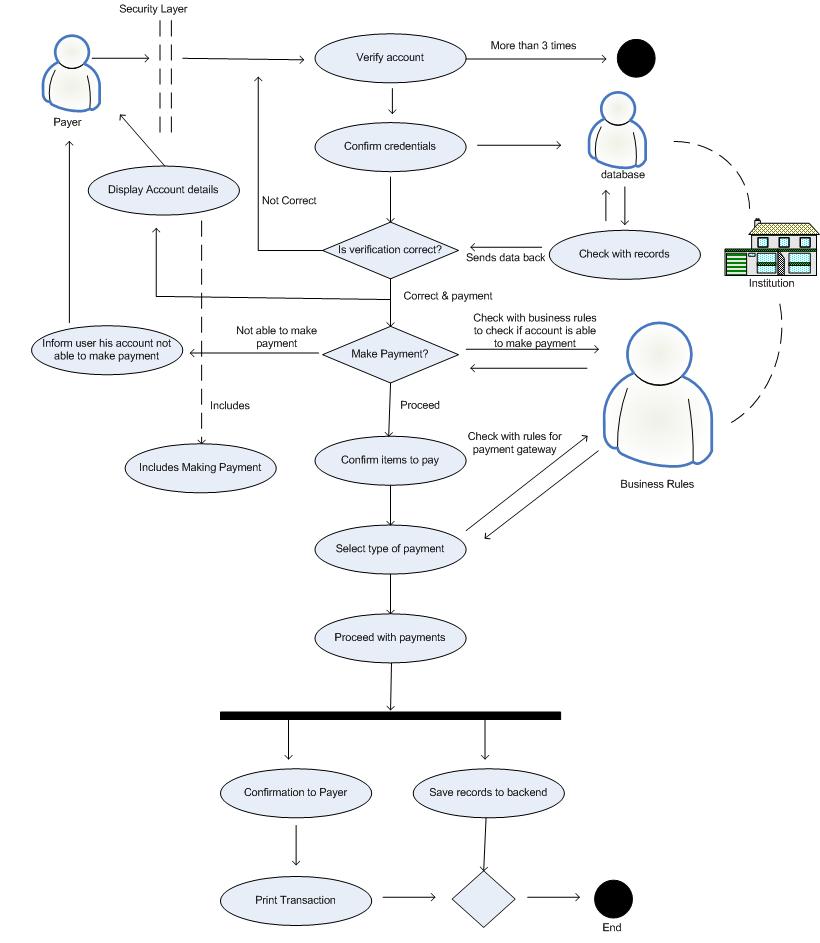
I have created a short requirement analysis based on a company doing e-commerce payments system. I have not talk to any of the stakeholders and the information i gathered is based on its software workflow and the information it provides on their webpage.
一个公司创建电子商务的支付系统创建了一个简短的需求分析. 我的资料收集是基于其软件的工作流程和我所收集资料, 都是从他们的网页读和分析的。

When i need to gathered requirements, this is how i will look at a process before implementing the necessary codes to create a system.
当我需要收集需求分析资料的时候,这就是我会在这个过程在实施必要,然后再创建一个系统

A short example of my use-case:


For their system doing payments, i will list down the key payment business rules in the system.

Types of Payments from users with different sets of business rules:

  • Credit Cards
  • Debit Cards
  • E-Giro
  • Remittance
  • Mobile E-banking users
  • Pay-pal
  • Corporate Accounts
  • Bank branches/Foreign banks
Next i will break down the scenario into cases.


Scenario breakdown:

  1. Get the user account number and location
  2. Send the credentials
  3. Check and verify
  4. Ask security questions
  5. Permit access to the account
  6. View payment items
  7. User confirms the payment and sends in the payment details
  8. Business rules to determine the type of settlement services
  9. Confirm the settlement at the back office
  10. Confirm settlement to user
Define what are the normal case scenarios


Normal Case Scenarios

1. Inputs: User account, password, objects to make payments for. Output: Records inserted into the back end and confirmation made to the payer

The payer’s account number, password, purchased items and his account are both constraints on the work. His account number comes from outside, which is the account number & password that he needs to input. The record account is a constraint imposed by the bank system; in this case, it cannot be changed.
However, the account number, password, purchased items and his account are means to an end the real work to be done is to make the payment transaction. 

2. The implementation of the security encapsulation protocols to transfer data
The use of the security features such as SSL to transfer payer details


3.  Ensure the payer is correctly identified and connected to the right account.

4. Check the payer account is valid and belongs to the payer.
  • The account must be current in used.
  • Enough funds in his account
  • Credit limit is not exceed
  • Displays his payment history
What is the main goal of this process?
Business Event: Payer decides to make payment

What are the information that must be available before the system will starts the functions?
Trigger: Payers account, password, purchased items list/payment items, account database

Preconditions: The payer must have an account

Interested stakeholders: Types of payment account(Visa, Mastercard, E-banking, Paypal, etc), Payment List, workflow, security, goal of the transaction

Active stakeholders: Payer, Institutions
  • Verify the payer’s account
  • Transfer data using security encryption
  • Check the account is valid
  • Check with business rules to ensure the account can be used.
  • Verify the items which payment is to be made
  • Select the type of payment
  • Check with the business rules to select the type gateway
  • Process with payment and record in the backend
  • Process with payment and sends confirmation to payer.

 This alternative case scenarios states how payers will get to choose their desired payments and system will wait for their input before processing.

Alternative Case Scenarios


5. Using payment Gateway to make payments

In this scenario, alternative case can arrive when it comes to choosing which payment gateway.
Consider this step 5 scenario:
  • Choose to use the Visa/Master, Paypal, and etc gateway based on business rules engine to select payers’ payment preferences
  • Using the guiding payment rules to facilitate the transaction work flow

In any case, sometimes we need to cater for systems that encounter exception scenarios for eg: Something disrupts the workflow and how we can introduce solutions to rectify them


Exception Cases


6. The goal of this exception case is to show how we can handle exceptions when the business workflow deviates from the goal.

Some of the exceptions can be:
  • What happens if the server is loaded and transaction process is taking a long time?
  • What happens if there is error encountered while inserting records in the database?
  • What can go wrong in these steps?

Solutions:
  1. Some solutions to solve the stress of the servers can be using the load balancer to move the load of users to different servers
  2. Using the cluster server to handle the load, for eg: if one of the server is down, the second server can be kick start to continued the process
  3. Implement the functions in the business rules to synchronize the methods for inserting data
  4. Solutions to handle the error in data insertion will be having a rollback mechanism in the business logic to prevent duplications or dirty records
Next we need to cater for misuse cases or scenarios that are unwanted or will be causing disastrous results to the system.


Misuse Cases & Negative Scenarios


7. This case may surface when an antagonist uses someone’s account to make transactions.

Scenarios to stop/prevent the misuse
  • The payer key in an incorrect password for an account that is not his
  • Allow the antagonist to key in 3 times (this is for ebanking account)
  • Freeze/lock the account when the password is incorrect(this is for ebanking account)
  • Send an sms if payment exceed a certain amount (for credit cards)
Finally the goal to the system

Outcome

The payment is make successfully, records retained at the institutions’ backend and confirmation make to payers’ records.


Lastly some of the test cases that we can implemented to make sure the system is well prepared for users usage:


Types of testing to deployed


  • Unit Testing (Component Testing) – testing of individual module components as they are completed. 
  • Integration Testing – testing to integrate multiple modules
  • User Acceptance Testing – testing by users/customer to get approval that business flow is correct and what they want
  • Functional Testing (Black Box Testing) – testing done to ensure the final output is what the user/customers want
  • Usability Testing – testing for users where they can get to understand more about  the application, as well as the users’ efficiency and productivity.
  • Performance Testing (Load Testing, Stress Testing) – refers to testing performed to evaluate whether the system. Eg: Use idx-tsunami stress tool to simulate a high number of users and emulate the using of the system at the same time


Chapter 27: Theory of Common stock investment

According to the the authors, stock analysis are commonly impaired by 2 factors:
  • The instability of the tangible assets as most of the time, they are not worth the exact market value when the company is distress or deflation in economy
  • The difficulty of estimating the intangibles assets and most of the time, they do not worth as much as what the management sees. However there are some exceptions where a company worth depends on its intangibles such as Coca Cola.
Author classify speculative stock as:
  • It paid no dividends
  • Earnings where irregular and sometimes its profits may cover barely its expenses
  • A stated part of its stated value represented no actual investment in business

Author classify investment stock as:
  • Earnings where stabke abd in excess of dividends paid
  • Having a satisfactory record of dividend handouts to investors
  • each dollar of stock was backed by a dollar or more of actual investment in business
Value investing focus on recurring income instead of focusing on growing of principal. Use past records and earnings to determine and estimate the value of a stock instead of forecasting the future earnings.

New era theory
  • In this era, investors look for investments by looking at dividends and believe that it has a slight bearing upon the value
  • No relationship existed between assets and earning power, asset value was entirely devoid of importance
  • Pas earnings are use to estimate what changes were likely to take place in future and not using it to estimate the stability of a company
There are a few obstacles trying to forecast earnings are:
The law of diminishing returns
Increased competitiveness from competitors
The ups and downs of the economy cycle where the company stock may look impressive due to the fact that it is at the top cycle of the economy cycle and as the law of nature states, what goes up will go down eventually. Therefore beware of buying at this time and the fall of the economy cycle will bring down the profits of the company

Friday, 1 April 2011

Lets use Commands for Linux Partitioning

Nowadays with so much improvements contribute to Linux makes this OS easier for the users as compared 10 yrs ago.
1 significant improvement to Linux is the partition of the disk. Users in these days can simply use the GUI interface or software such as G-Part to partition instead of using commands.
However for me, being a fan of Linux OS, it will be somehow a feeling of dissatisfaction without trying to partition using Linux commands. Today i will blog how i partition using the hard disk in Linux without using GUI.

To save time and to print some screens on how it works, i will use DLX OS using the Bochs Virtual Environment. Below are the steps of how i install DLX into Bochs Env using the Windows system. If you happened to read this post and you like to try partitioning using Linux, simply skip the Bochs part:)

如今有这么多的改善作出贡献的Linux,更十多年前比起来,真的是比较容易多了。
一个显着改善Linux,就是磁盘分区。
在这个世纪里,用户可以简单地使用GUI界面或如G-Part软件进行分区,而不是使用Unix/Linux的命令。
然而,对于我来说,Linux操作系统的风扇喜爱者,不尝试使用Unix/Linux的命令分区磁盘,将是某种的不满情绪.
今天我将博客我是如何分区硬盘,不使用GUI界面在Linux。

为了节省时间,并打印它是如何工作的一些画面,我将用DLX的操作系统使用Bochs的虚拟环境。
下面是我的步骤,如何使用Windows系统安装 DLX在 Bochs的环境中。
如果你碰巧看到这篇文章,你想尝试使用Linux分区,请跳过Bochs这一部分

First i create a disk image in Bosch as shown below:
博世创建一个磁盘映像:


Now i will copy the DLX image into the Bochs directory.
复制DLX形象Bochs的目录中


The boch.bxrc file.
boch.bxrc文件。

Now go into the dxlinux and click on the run.bat file to start the program. I will be looking at the screen as shown below:
点击进入dxlinuxrun.bat文件.
Log in as root:
以root身份登录:

Start partioning the drive.
开始磁盘分区
Type fdisk –l to see the status of the disk:


Type fdisk /dev/hdb to start portioning

The steps below are used to partition in sequence.40M means 40MB
下面的步骤是用来磁盘分区
  1. Select ‘p’ to partition.
  2. Enter 1 to partion hdb1
  3. Enter 40M for memory
  4. Enter ‘n’ to partition
  5. Enter ‘p’
  6. Enter 2 to partition hdb2
  7. Enter 40M for memory
  8. Repeat the steps of 1 to 7, however at step 2, enter 3 and 4 to partition each HD respectively as well as hdb3 for 10M and hdb4 for 10M
  9. In total based on the steps just listed, i'm creating 4 partitions. Normally we create partitions for root partition, home partition and swap partition. I prefer to create another 1 more partition to store important documents or files.  
  10. 在对刚刚上市的步骤的基础总额我创建4个分区


After setting the necessary partition, we need to write/register the partitions.
Enter or type 'w' to write the partition into the system. It should return: 'Partition table has been altered'
在设置了必要的分区,我们需要编写/注册分区。


Now check the partition of my disk using fdisk -l. It should list 4 partitions in the disk. 
检查我的磁盘分区使用fdisk- 1 


Lets create the file systems for each individual partitions by typing the following commands:
创建文件系统:


1)      mke2fs /dev/hdb1
2)      mke2fs /dev/hdb2
3)      mke2fs /dev/hdb3
4)      mke2fs /dev/hdb4

Below is the confirmation of creating the file systems:


Now i will be creating directories and mount each directory to a partition. Its like mounting a thumbdrive into Linux. To mount, we need to create a directory so that it can connect to the thumbdrive or partition and we can access the data in the partition by accessing the directory.
Create the 4 directories first (any name i want)
创建目录和每个目录挂载到分区。:
  1. mkdir /web
  2. mkdir /usr/local
  3. mkdir /usr/local/spare
  4. mkdir /home


Mounting the partitions to the respective directories.
  1. Mount –a /dev/hdb1 /home
  2. Mount –a /dev/hdb2 /usr/local
  3. Mount –a /dev/hdb3 /usr/local/spare
  4. Mount –a /dev/hdb4 /usr/home


Type df-k to see the mounted directories:

This should end how to partition and mounting of file systems.
这应该结束如何分区和文件系统的安装。

Cash flow Forecasting

Why cash forecasting? A cash forecasting model is an essential tool for treasuer to manage working capital. Forecasting preempt treasurer ...